
Why This Guide Exists
Every August, the monsoon refills tanks and borewells across India and, with it, the annual spike in waterborne illness begins. The jar of municipal water that was drinkable in May is suddenly carrying sediment, dissolved salts, and microbial load. This is the month households across Delhi, Mumbai, Bengaluru and everywhere in between start shopping for a water purifier, often in a hurry, often with the wrong questions.
The confusion is understandable. Walk into any appliance store or scroll Amazon India and you are buried in jargon: RO, UV, UF, TDS controller, mineral fortification, alkaline, copper. This guide is built to cut through it. We compare the four technologies that matter, explain which one fits your water source, and name four real purifiers we have verified are in stock and well reviewed on Amazon India right now, priced from roughly Rs 9,000 up to Rs 16,000, the sweet spot for a family of four.
How to Choose: Match the Technology to Your Water
The single biggest mistake Indian buyers make is buying an RO when they do not need one, or buying a UV-only unit when their water is hard. Here is the decision in plain language.
Know your TDS first. TDS, or Total Dissolved Solids, is the single number that decides everything. A Rs 150 TDS meter from Amazon will tell you in ten seconds. Below 200 ppm means your water has low dissolved salts, typically municipal supply in cities like Mumbai and Chennai. Above 500 ppm, common with borewell water in Delhi, Jaipur and Hyderabad, is high TDS and demands RO. Between 200 and 500 ppm is the grey zone where a TDS-controllable RO or a good UF+UV unit both work.
RO (Reverse Osmosis) forces water through a membrane that strips out dissolved salts, heavy metals like arsenic and lead, and most microbes. It is the only technology that lowers TDS. The trade-off is that it wastes roughly three litres of reject water for every litre of purified water, unless the model recirculates it back to your overhead tank. RO is non-negotiable for borewell water above 500 ppm.
UV (Ultraviolet) kills bacteria and viruses with UV light but does nothing to dissolved salts or heavy metals. It is perfect for municipal water that is microbiologically suspect after the monsoon but already low in TDS. UV units waste no water and need only bulb and filter changes.
UF (Ultrafiltration) uses a coarser membrane that removes suspended solids and most microbes but cannot reduce TDS. Useful as a pre-stage in RO+UV+UF combos and as a standalone only for already-soft municipal water.
What to actually look for in 2026: an in-tank UV LED (keeps stored water sterile, a real monsoon advantage), a TDS controller or mineraliser (so RO does not strip your water to dead zero), a water-saving rating (modern ROs save 60 to 70 per cent versus the old 25 per cent), and a clear service cost plan. Filter replacement is where the real money goes, so a model with bundled two-year service is worth more than a Rs 2,000 lower sticker price.
Our Top Picks
We shortlisted models that combine verified Amazon India availability, a minimum of 500 real customer reviews, and a technology mix that genuinely fits an Indian water source rather than just a marketing checkbox. All four are RO+UV+UF combos because that is the only configuration that safely handles mixed municipal, tanker and borewell water, which is what most urban households actually receive.
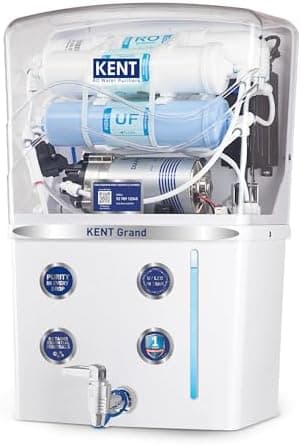
1. KENT Grand, RO+UF+TDS Control, 8 Litre
This is the safe default. The KENT Grand has been the largest-selling RO in India for several years running, and the reason is boring and good: it just works, the service network is the widest in the country, and parts are easy to find even in tier-three cities. It uses RO with a UF stage and a TDS controller that lets you dial the output TDS back up so the water does not taste flat. The 8 litre storage is enough for a family of four between refills, and the in-tank UV LED keeps the stored water safe for up to 24 hours. Flow rate is a healthy 20 litres per hour. The one real criticism is water recovery is the older standard, roughly 25 per cent, so you will see reject water. In a water-scarce city, that matters.
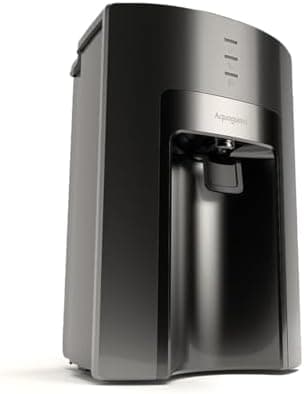
2. Aquaguard Delight NXT Aquasaver, RO+UV+UF
If you are in Delhi, Bengaluru or any city where every drop of water counts, the Aquasaver variant is the one to look at. Eureka Forbes claims up to 60 per cent water saving versus a conventional RO by recirculating reject water, and the 8,924 verified reviews on Amazon back up that it does meaningfully better than older Aquaguard models on waste. You get RO, UV and UF in one unit, a 6 litre tank, and Aquaguard patented Active Copper and Mineral Guard tech that adds back some mineral content post-RO. Installation and service quality is the variable here: in metros it is excellent, in smaller towns it can be patchy, so check the service centre density for your pin code before buying.
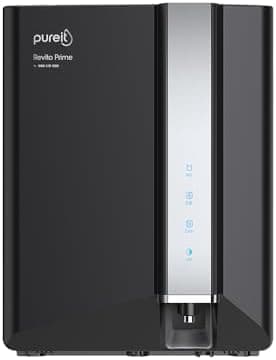
3. Pureit Revito Prime, RO+MF+Mineral+UV, 8 Litre
The Revito Prime is the pick for households who want a genuinely modern purifier, not a refresh of a 2018 model. HUL Pureit DURAViva cartridge is rated for up to 8,000 litres, the highest in this list, which means fewer filter changes and lower running cost over two years. It carries a 7-stage process including a mineraliser and in-tank UV, and Pureit rates it at up to 70 per cent water saving, the best recovery figure here. The catch is the review count is still low at 515, because the model is relatively new, so long-term reliability data is thinner than for the KENT or Aquaguard. At its current price it is the best value-for-features pick on this list if you are comfortable being an early adopter.
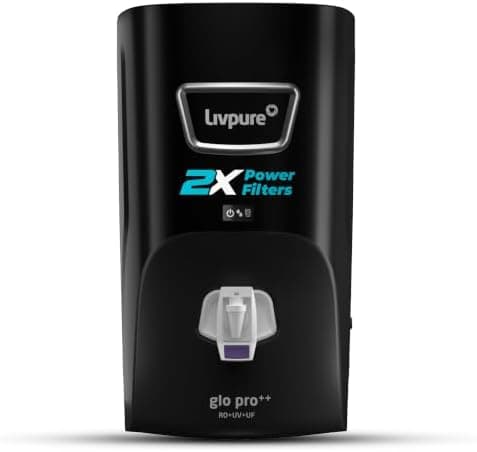
4. Livpure Glo Pro++, RO+UV+UF, 7 Litre
The Livpure Glo Pro++ is the budget pick that does not feel like a budget pick. The standout is the two-year no-filter-cost plan, which saves you roughly Rs 8,000 to Rs 21,000 in consumables over two years depending on usage, a number Livpure puts in the listing and that holds up against what customers report paying for competing filters. You get full RO+UV+UF, a 7 litre tank and the same borewell, tanker and municipal suitability as the others. The build quality is a step below KENT and Aquaguard, the plastic feels lighter, and the pump is a touch noisier on startup. At nearly Rs 3,000 less than the KENT Grand, that is the trade-off you are accepting, and for most kitchens it is a fair one.
Quick Comparison
| Model | Tech | Storage | Water Saving | Price (approx) | Best For |
|---|---|---|---|---|---|
| KENT Grand | RO+UF+TDS | 8 L | Standard | Rs 11,899 | Safe default, widest service |
| Aquaguard Delight NXT Aquasaver | RO+UV+UF | 6 L | Up to 60% | Rs 9,499 | Water-scarce cities |
| Pureit Revito Prime | RO+MF+Mineral+UV | 8 L | Up to 70% | Rs 15,999 | Lowest running cost |
| Livpure Glo Pro++ | RO+UV+UF | 7 L | Standard | Rs 8,999 | Best budget, 2yr free filters |
A note on the prices above: they reflect the current Amazon India listing at the time of writing and move with sales. Always click through to confirm the live price before buying. The two-year running cost, not the sticker price, is what you actually pay for a water purifier.
Final Verdict
If you want a single recommendation and your water source is a mix of municipal and tanker, buy the KENT Grand. It is the least exciting choice here and exactly the right one: proven, serviceable anywhere in India, and the 8 litre tank is right for a family. If you live in a water-scarce city, switch that recommendation to the Aquaguard Delight NXT Aquasaver because the water saving is not a marketing claim, it is a real Rs-200-a-month reduction in your water bill in a household that runs the purifier daily.
If your priority is the lowest total cost of ownership over two years, the Pureit Revito Prime wins on cartridge life and water recovery, and the Livpure Glo Pro++ is the right call if your budget is firmly under Rs 10,000 and you value the bundled two years of free filters over a premium build.
Buy the purifier that matches your water, not the one with the best discount. Run a TDS test first, then decide. A Rs 150 meter will save you from buying the wrong Rs 15,000 machine.
Frequently Asked Questions
Do I need RO if my municipal water TDS is under 200?
No. RO on low-TDS water over-purifies and strips useful minerals. A UV or UF unit, or a purifier with a TDS bypass, is the correct and cheaper choice. RO only earns its place when your TDS crosses roughly 500 ppm.
How much water does an RO purifier waste?
Older conventional ROs recover only about 25 per cent of input water, wasting three litres per litre purified. Modern water-saving models like the Aquaguard Aquasaver and Pureit Revito Prime recover 60 to 70 per cent. If you are in a water-scarce city, a water-saving model is worth the extra cost.
How often do I need to replace the filters?
Typically every 6 to 12 months for the pre-sediment and carbon filters and every 12 to 24 months for the RO membrane, depending on input water quality and usage. Models with high-capacity cartridges like the Pureit Revito Prime extend membrane life to roughly 8,000 litres.
Is in-tank UV necessary?
It is a genuine upgrade, not a gimmick. Stored purified water can grow bacteria if it sits for over 24 hours, which is exactly the monsoon scenario. An in-tank UV LED keeps stored water sterile and is worth paying a small premium for.